
When a healthcare provider submits a claim to an insurance company, they expect to get paid for their services. However, sometimes the insurance company refuses to pay. This refusal is called a “denial.”
A denial happens when an insurance company reviews a claim and decides not to pay it. This can occur for many reasons, such as missing information, coding errors, or eligibility issues.
Understanding denials is crucial because they directly impact how medical practices earn money.
Denials can seriously hurt a practice’s revenue. When claims get denied, the practice doesn’t receive payment for the care services they provided.
Studies show that healthcare practices lose billions of dollars each year due to denied claims. Some denials never get resolved, which means the practice loses that money forever.
Fortunately, denials can be managed effectively through a systematic approach called denial management. This process involves tracking denials, finding out why they happened, fixing the problems, and preventing them in the future.
Many healthcare practices struggle to manage denials on their own because it requires specialized knowledge and dedicated staff. This is where outsourced medical billing companies come in.
They use proven strategies and advanced technology to reduce denials and recover lost revenue for healthcare practices.
What is Denial Management in Medical Billing?
Denial management in medical billing is the process of handling claims that insurance companies refuse to pay. It includes identifying denied claims, understanding why they were denied, correcting the errors, and resubmitting them for payment. Moreover, it involves analyzing denial patterns to prevent future denials from happening.
Understanding Denials in Medical Billing
A denial in medical billing occurs when an insurance payer refuses to reimburse a healthcare provider for services rendered to a patient. The insurance company sends back the claim with a specific reason code explaining why they won’t pay. That code is called denial code.
Denials differ from rejections. A rejection happens before the claim enters the insurance company’s system, usually due to technical errors. In contrast, a denial occurs after the insurance company reviews the claim and makes a decision not to pay.
There are two main categories of denials: hard denials and soft denials. Hard denials are permanent and cannot be recovered unless the provider appeals the decision. Soft denials are temporary and can be corrected and resubmitted for payment. Understanding this difference helps billing staff prioritize which denials to work on first.
Types of Denials in Medical Billing
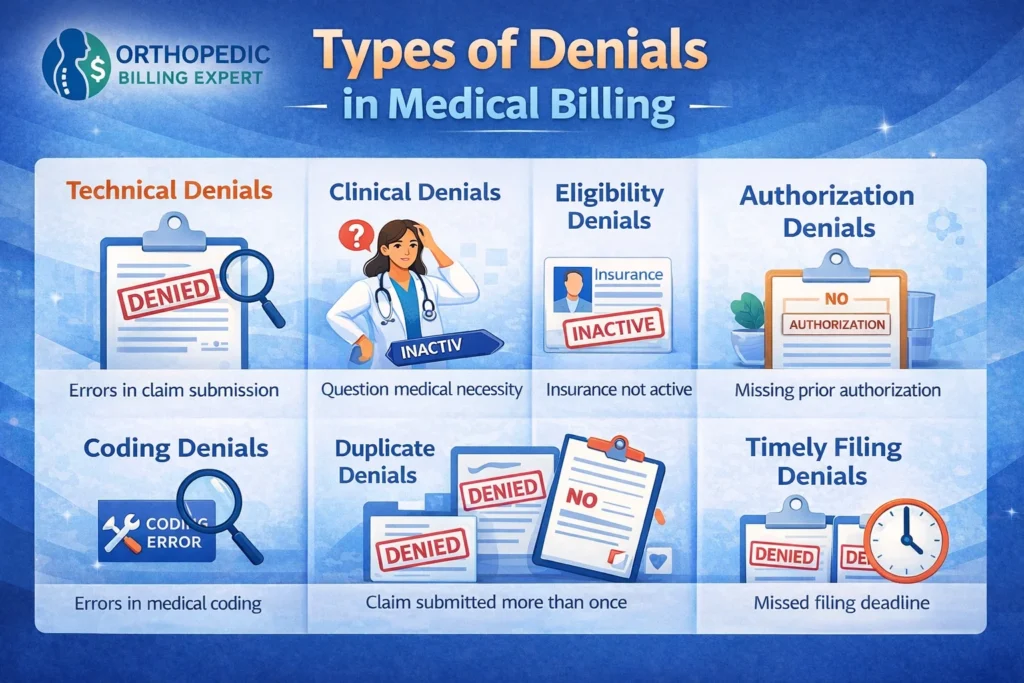
Denials come in various forms, each requiring different solutions. Here are the main types:
Technical Denials
Technical denials occur due to errors in claim submission. These include incorrect patient information, missing data fields, or invalid insurance identification numbers. Technical denials are often easy to fix once identified.
Clinical Denials
Clinical denials happen when the insurance company questions the medical necessity of the treatment. They may believe the service wasn’t needed or that a less expensive alternative should have been used.
Eligibility Denials
Eligibility denials occur when the patient’s insurance coverage is not active on the date of service. This might happen if the patient’s policy expired, was canceled, or never existed.
Authorization Denials
Authorization denials result from providing services without obtaining required prior authorization from the insurance company. Many procedures need approval before they’re performed.
Coding Denials
Coding denials arise from errors in the medical codes used on the claim. This includes using outdated codes, incorrect codes, or codes that don’t match the diagnosis.
Duplicate Denials
Duplicate denials happen when the same claim is submitted more than once, and the insurance company has already processed the first submission.
Timely Filing Denials
Timely filing denials occur when claims are submitted after the insurance company’s deadline. Each payer has specific time limits for claim submission.
Steps of Denial Management in Medical Billing
Successful denial management follows a clear process with specific steps:
Step 1: Identification
The first step involves identifying which claims have been denied. Billing staff must regularly check payment reports and explanation of benefits (EOB) documents to spot denials quickly.
Step 2: Categorization
Once identified, denials must be sorted by type and reason. This helps staff understand patterns and prioritize which denials to address first.
Step 3: Analysis
must carefully review each denial to understand exactly why it was rejected. This involves reading the denial code, checking the patient’s information, and reviewing the original claim.
Step 4: Correction
After understanding the problem, staff must fix the error. This might mean updating patient information, changing codes, adding missing documentation, or correcting billing details.
Step 5: Resubmission
The corrected claim must be resubmitted to the insurance company with all necessary corrections and supporting documents.
Step 6: Tracking
Staff must track resubmitted claims to ensure they get processed and paid. This prevents claims from falling through the cracks.
Step 7: Reporting
Regular reports should be created to monitor denial rates, types of denials, and resolution times. This data helps identify areas for improvement.
Step 8: Prevention
The final and most important step involves using what was learned to prevent future denials. This means updating processes, training staff, and implementing quality checks.
How to Manage Denials in Billing
Managing denials effectively requires both reactive and proactive strategies. Here’s how successful practices handle denials:
Establish a Dedicated Team
Assign specific staff members to handle denials. These team members should receive special training in denial management and insurance regulations.
Use Technology
Implement billing software that automatically flags denials and tracks their status. Many modern systems can identify denial patterns and alert staff to recurring problems.
Create a Workflow
Develop a standard process for handling denials from start to finish. Everyone on the team should follow the same steps to ensure consistency.
Set Priorities
Not all denials are equal. Focus first on high-dollar claims and soft denials that can be easily corrected. This maximizes revenue recovery.
Document Everything
Keep detailed records of all denial work, including what was done, when it was done, and the outcome. This documentation helps with appeals and prevents duplicate efforts.
Communicate with Payers
Build relationships with insurance company representatives. Regular communication can help resolve denials faster and prevent future issues.
Train Staff Regularly
Insurance rules change frequently. Provide ongoing training to keep staff updated on coding changes, payer requirements, and best practices.
Measure Performance
Track key metrics such as denial rate, overturn rate, and average time to resolution. Use this data to identify problems and measure improvement.
Learn from Patterns
If the same type of denial keeps happening, investigate the root cause. Fix the underlying problem rather than just treating symptoms.
Appeal When Necessary
Some denials are incorrect. Don’t hesitate to appeal decisions when you have supporting documentation and believe the claim should be paid.
Understanding Denial Codes in Medical Billing
Denial codes are standardized codes that insurance companies use to explain why they denied a claim. These codes are essential because they tell billing staff exactly what went wrong and what needs to be fixed.
Every denial code has a specific meaning. Learning these codes helps billing staff resolve denials quickly without having to call the insurance company for clarification. Denial codes are usually listed on the Explanation of Benefits (EOB) or Electronic Remittance Advice (ERA) that the insurance company sends.
The codes typically consist of letters and numbers. The letters indicate the category of the denial, while the numbers provide more specific information about the problem. Understanding these codes is like learning a language – once you know them, you can communicate effectively with insurance companies.
Types of Denial Codes in Medical Billing
Denial codes are divided into different categories based on who is responsible for the denied amount. Here are the main types:
PR Codes (Patient Responsibility)
These codes indicate that the patient is responsible for the denied amount. The insurance company won’t pay, but the provider can bill the patient. Common reasons include deductibles not met, services not covered by the patient’s plan, or copayment amounts.
CO Codes (Contractual Obligation)
These codes mean the provider cannot bill the patient for the denied amount due to contractual agreements with the insurance company. The provider must write off this amount. This often happens when charges exceed the allowed amount under the provider’s contract with the payer.
OA Codes (Other Adjustment)
These codes represent adjustments that don’t fit into PR or CO categories. They might relate to third-party liability situations or other special circumstances.
PI Codes (Payer Initiated)
These codes indicate adjustments initiated by the insurance company for various administrative reasons. The provider usually cannot bill the patient for these amounts.
Each category serves a specific purpose in the billing process and determines what actions the provider can take next. Understanding which type of code you’re dealing with is crucial for proper claim follow-up.
Top 20+ Denial Codes in Medical Billing
Here is a comprehensive list of the most common denial codes that medical billing staff encounter:
1. CO-16 (Claim lacks information)
This denial means the claim is missing necessary information or has incomplete data. To fix it, review the claim carefully, add the missing information, and resubmit. Common missing items include diagnosis codes, procedure codes, or patient demographics.
2. CO-22 (Exceeds the contracted/legislated fee)
The billed amount is higher than what the insurance company allows under the contract. Providers must adjust the charge to the allowed amount and cannot bill the patient for the difference.
3. CO-23 (Impact of prior payer adjudication)
This occurs when a secondary insurance adjusts payment based on what the primary insurance paid. No action is usually needed as this is informational.
4. CO-24 (Charges are covered under a capitation agreement)
Services are already covered under a capitation payment arrangement. The provider cannot bill separately for these services.
5. CO-27 (Expenses incurred after coverage terminated)
Services were provided after the patient’s insurance coverage ended. Verify the patient’s coverage dates and either appeal with proof of coverage or bill the patient.
6. CO-29 (Time limit for filing has expired)
The claim was submitted after the payer’s filing deadline. Some payers may accept appeals with proof of timely filing. Otherwise, the claim cannot be paid.
7. CO-45 (Charge exceeds fee schedule/maximum allowable)
Similar to CO-22, the charged amount exceeds what the payer allows. Adjust the charge and write off the difference.
8. CO-50 (Non-covered services)
The service provided is not covered by the patient’s insurance plan. The provider can bill the patient if they have an advance beneficiary notice (ABN) signed.
9. CO-96 (Non-covered charges)
Similar to CO-50, these charges are not covered. Review the patient’s plan to understand coverage limitations.
10. CO-97 (Benefit for this service is included in another service)
The service is considered part of another procedure and cannot be billed separately. This is called “bundling.” Accept the bundled payment and don’t bill separately.
11. PR-1 (Deductible amount)
The patient hasn’t met their deductible yet. Bill the patient for this amount as it’s their responsibility.
12. PR-2 (Coinsurance amount)
This is the patient’s share of the cost after the deductible is met. Bill the patient for their coinsurance percentage.
13. PR-3 (Copayment amount)
The fixed amount the patient must pay for the service. Collect this from the patient.
14. CO-4 (Procedure code inconsistent with modifier)
The modifier used with the procedure code doesn’t make sense or is incorrect. Review and correct the modifier, then resubmit.
15. CO-11 (Diagnosis inconsistent with procedure)
The diagnosis code doesn’t support the medical necessity of the procedure performed. Review the documentation and use a more appropriate diagnosis code that justifies the service.
16. CO-15 (Authorization number missing, invalid, or does not apply)
The required authorization number is missing or incorrect. Obtain the correct authorization number and resubmit.
17. CO-18 (Exact duplicate claim/service)
The claim is a duplicate of one already submitted. Check if the original claim was paid. If not, contact the payer. If yes, no action is needed.
18. CO-31 (Patient cannot be identified as our insured)
The patient information doesn’t match the insurance company’s records. Verify the patient’s insurance information and correct any errors.
19. CO-109 (Claim not covered by this payer)
The insurance company listed is not responsible for this claim. Verify the correct insurance and resubmit to the appropriate payer.
20. CO-151 (Payment adjusted because the payer deems the information incomplete)
The claim has incomplete or insufficient information. Add the missing details and resubmit.
21. CO-197 (Precertification/authorization/notification absent)
Required precertification or prior authorization was not obtained before providing the service. Attempt to obtain retroactive authorization if the payer allows it.
22. CO-204 (Service is not covered when performed in this place of service)
The location where the service was provided is not covered for this procedure. Verify the correct place of service code and billing requirements.
23. PR-96 (Non-covered charges, patient responsibility)
The service is not covered by insurance, and the patient must pay. Bill the patient directly with proper notice.
24. CO-B7 (Claim denied because benefits were exhausted)
The patient has used up their available benefits for this type of service. The patient is responsible for payment.
Common Denial Codes and Their Solutions
While we’ve covered many codes above, it’s helpful to understand the most frequent ones in more detail with practical solutions:
Missing Information Denials (CO-16, CO-151)
These are among the most common denials. The solution is straightforward: carefully review the claim form, identify what’s missing, add the required information, and resubmit. Common missing items include referring physician information, diagnosis codes, or procedure details. Implementing a checklist before claim submission can prevent these denials.
Timely Filing Denials (CO-29)
To avoid these denials, submit claims as soon as possible after services are provided. Most payers require submission within 90 days, but some have shorter deadlines. Set up a system to track submission deadlines and follow up on unpaid claims regularly. Some payers accept appeals with proof that the claim was submitted on time.
Authorization Denials (CO-15, CO-197)
Prevention is key for authorization denials. Verify authorization requirements before providing services. Maintain a database of which procedures require authorization for each payer. Train staff to obtain authorizations consistently. If a service was provided without authorization, some payers allow retroactive authorization requests within a specific timeframe.
Eligibility Denials (CO-27, CO-31)
Always verify patient insurance before the appointment. Use electronic eligibility verification systems that check coverage in real-time. Update patient information regularly and ask patients to confirm their insurance at each visit. When these denials occur, determine if there was a coverage gap or if the patient needs to update their insurance information.
Coding Denials (CO-4, CO-11)
Proper coding requires ongoing education. Ensure coders understand the documentation and select codes that accurately represent the services provided. The diagnosis must support the medical necessity of the procedure. When these denials occur, review the medical record, select more appropriate codes, and resubmit with supporting documentation if needed.
Duplicate Denials (CO-18)
Keep detailed records of all claim submissions. Before resubmitting a claim, check if it was already processed. Implement a claim tracking system that prevents accidental duplicate submissions. If you receive a duplicate denial, verify the original claim’s status before taking action.
Top 10 Denials in Medical Billing
Based on industry data, here are the ten most frequent denials that medical practices face:
1. Missing or Invalid Information
This is the number one cause of denials across all specialties. Claims are denied because of missing patient information, incorrect insurance details, or incomplete provider information. The solution involves implementing quality checks before claim submission and using claim scrubbing software.
2. Services Not Covered by Payer
Many denials occur because the service provided isn’t covered under the patient’s plan. Verify coverage before providing services and obtain an Advance Beneficiary Notice (ABN) when services might not be covered.
3. Timely Filing Issues
Waiting too long to submit claims results in automatic denials. Establish clear workflows for prompt claim submission and track pending claims regularly.
4. Authorization Required but Not Obtained
Many procedures require prior authorization, and providing services without it leads to denials. Create a robust authorization tracking system and verify requirements before scheduling procedures.
5. Duplicate Claims
Submitting the same claim twice causes denials. Better claim tracking systems and communication between staff members can prevent this issue.
6. Patient Not Covered on Date of Service
Insurance coverage changes frequently, and patients don’t always update their information. Verify eligibility at every visit, not just at the first appointment.
7. Coding Errors
Wrong codes, unbundling issues, and lack of specificity in coding lead to denials. Invest in coder training and stay updated on coding changes.
8. Registration Errors
Mistakes made during patient registration, such as wrong birthdate or misspelled name, cause denials downstream. Train front desk staff on the importance of accurate data entry and implement verification procedures.
9. Medical Necessity Not Established
Insurance companies deny claims when they believe the service wasn’t medically necessary. Ensure documentation clearly supports the need for services provided.
10. Coordination of Benefits Issues
When patients have multiple insurance policies, claims can be denied if sent to the wrong payer first. Always determine which insurance is primary and bill in the correct order.
The Role of Outsourced Medical Billing Companies in Denial Management
Outsourced medical billing companies have become essential partners for healthcare practices struggling with denials. These specialized companies offer several advantages in managing denials effectively.
Expertise and Knowledge
Outsourced billing companies employ certified coders and billing specialists who understand complex insurance rules and regulations. They stay updated on changes in coding systems, payer policies, and industry best practices. This expertise translates into fewer denials and faster resolution of denied claims.
Advanced Technology
Professional billing companies invest in sophisticated software systems that automate denial tracking, identify patterns, and prioritize work queues. These systems can catch errors before claims are submitted, reducing the initial denial rate significantly.
Dedicated Resources
Unlike in-house staff who may juggle multiple responsibilities, outsourced companies have teams dedicated solely to denial management. They can devote the necessary time and attention to researching, correcting, and resubmitting denied claims.
Cost Effectiveness
While outsourcing has costs, it often proves more economical than hiring and training in-house staff. Practices avoid expenses related to salaries, benefits, training, software, and ongoing education. Additionally, improved denial resolution directly increases revenue.
Performance Metrics
Reputable billing companies provide regular reports showing denial rates, resolution times, and recovery amounts. This transparency helps practices understand their billing performance and identify areas for improvement.
Scalability
Outsourced companies can easily handle fluctuations in claim volume. Whether a practice is growing or experiencing seasonal changes, the billing company adjusts resources accordingly.
Focus on Patient Care
By outsourcing billing and denial management, healthcare providers can focus on what they do best: caring for patients. Staff time previously spent on billing issues can be redirected to patient services.
Higher Success Rates
Statistics show that outsourced billing companies typically achieve higher clean claim rates and lower denial rates compared to practices handling billing internally. Their specialized focus and resources lead to better outcomes.
When selecting an outsourced billing company, practices should look for proven experience in denial management, transparent reporting, knowledge of their specific specialty, and a track record of reducing denial rates and increasing collections.
Conclusion
Denial management in medical billing is a critical function that directly impacts a practice’s financial health. Understanding what denials are, why they occur, and how to manage them effectively can mean the difference between a thriving practice and one struggling with cash flow problems.
Outsourced medical billing companies offer valuable expertise and resources for practices that lack the internal capacity to manage denials effectively. Their specialized knowledge, advanced technology, and dedicated focus on billing operations often result in better financial outcomes for healthcare providers.