
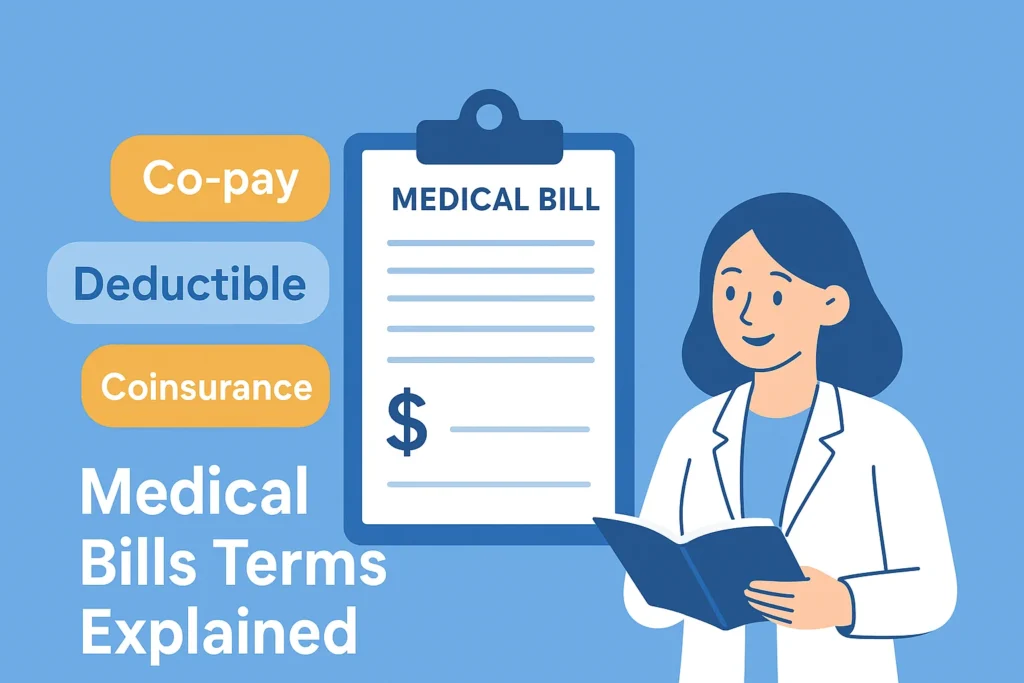
Medical bills can be confusing. They are full of strange words, codes, and numbers. For many people, it feels like reading another language. But don’t worry. Most of the terms are easy to understand once you break them down. This guide explains the most common medical bill terms in plain, simple words.
Patient Responsibility
This is the amount a patient must pay. It includes things like co-pays, deductibles, and coinsurance.
Example:
If your visit costs $200, insurance pays $150, your patient responsibility is $50.
Always check this number. It tells you how much money you need to pay the hospital or clinic.
Co-pay
A co-pay is a fixed amount the patient pays for a service, usually at the time of your visit.
Example:
You might pay $20 for a doctor visit, even if the visit costs $150.
Co-pays are usually small and easy to understand.
Deductible
A deductible is the amount a patient pays before your insurance starts covering your care expenses.
Example:
If your deductible is $500, you pay the first $500 of your medical costs. After that, insurance begins to pay.
Sometimes, you might pay part of the deductible for each service.
Coinsurance
Coinsurance is the percentage of the bill the patient pays after the deductible is met.
Example:
If your bill is $200 and your coinsurance is 20%, you pay $40. Insurance pays the rest.
Coinsurance is different from a co-pay because it’s a percentage, not a fixed amount.
Total Charges
This is the full cost of all services before insurance.
Example:
A visit might cost $300, but insurance might cover $240. Your total charges are still $300.
Always compare total charges with insurance payments to see what insurance is covering.
Insurance Payments
This shows how much patients’ insurance companies paid toward your bill.
Example:
Insurance may pay $240 out of a $300 bill.
If the insurance payment seems low, check if there was a mistake or if a service is not covered.
Line Items
Line items are the list of all services a patient received. Each service has a name, code, and price.
Example:
- Doctor visit (99213) – $150
- Blood test (80050) – $50
The codes are CPT codes. They help insurance companies know what service was done.
CPT Codes
CPT codes are numbers that represent medical services or procedures.
Example:
CPT 99213 is a common code for a doctor visit.
CPT 80050 is a code for a basic blood test.
You don’t need to memorize them, but knowing they exist helps you check your bill. However, if you want to know more about common CPT codes used in medical billing you can check some online resources.
ICD-10 Codes
ICD-10 codes are diagnosis codes. They explain why a patient got a certain service.
Example:
S52.5 means a broken forearm. The code S52.5 is an important code on the list of ICD-10 codes for orthopedics.
Insurance uses these ICD codes to decide if the service is covered. You can also check them if you want to understand why something was billed.
Adjustment / Write-Off
Sometimes the hospital reduces the bill. This is called an adjustment or write-off.
Example:
Your total charges might be $300, but $50 is written off. You don’t have to pay that part.
Adjustments happen when insurance covers part of the cost or the hospital gives a discount.
Balance Forward
Balance forward shows unpaid amounts from previous bills.
Example:
If you didn’t pay $30 from last month, the new bill might show a balance forward of $30.
Check this carefully to make sure old charges are correct.
Facility Fee
A facility fee is charged for using the hospital, clinic, or lab.
Example:
Getting an X-ray at a hospital might include a $50 facility fee.
This fee is separate from the cost of the service itself.
Explanation of Benefits (EOB)
An EOB is a paper from a patient’s insurance company. It shows:
- What your insurance paid
- What you owe
- Any adjustments
An EOB is not a bill, but it helps you understand your medical bill.
Paid by Insurance / Not Covered
Some services are not covered by insurance. The bill will show “Not Covered.”
Example:
Cosmetic procedures are usually not covered.
If something is marked “Not Covered” that you think should be, call your insurance company.
Payment Plan
A payment plan lets you pay your bill in smaller amounts over time.
Example:
You owe $200 but pay $50 per month for four months.
If you can’t pay the full amount, ask about a payment plan. It makes paying easier.
After reading these terms, now you will, I hope, no difficulty in understanding medical bills. Remember terms like co-pay, deductible, coinsurance, CPT codes, ICD-10 codes, and adjustments. These are common and appear on almost every bill.
Next time you get a bill, take it step by step. Check each section, ask questions if needed, and keep a record. Soon, reading medical bills will feel much easier. You don’t need to be an expert, just patient and careful.