
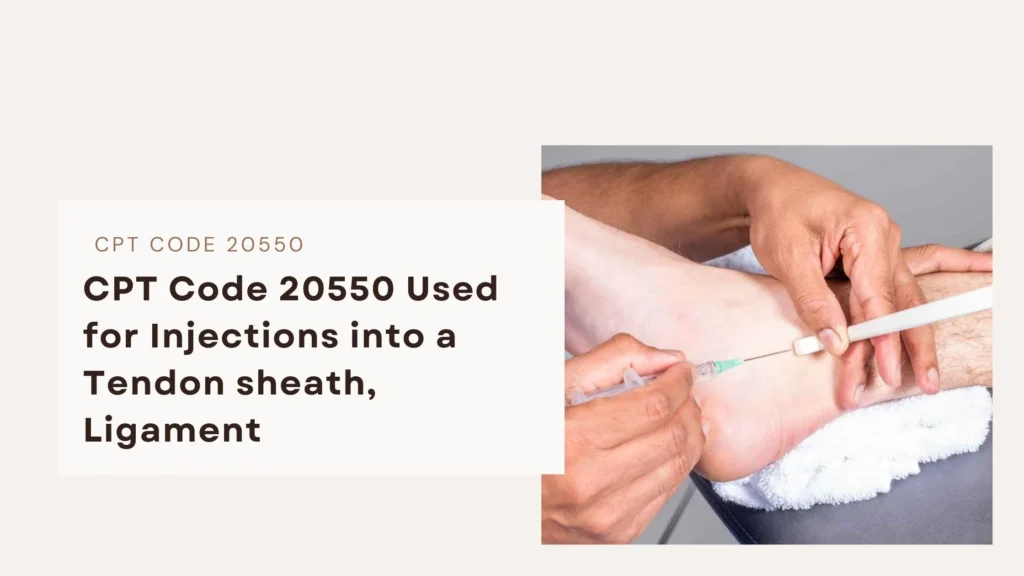
CPT code 20550 represents an injection procedure targeting a single tendon sheath, ligament, or tendon insertion. This CPT code falls under the musculoskeletal injection category and is commonly used in orthopedics, sports medicine, and primary care settings. The procedure involves administering therapeutic agents directly into affected soft tissue structures to reduce inflammation and provide pain relief.
CPT Code 20550 Description
The CPT code 20550 is used for injecting medicine into a tendon sheath, ligament, or fascia at one specific site to help reduce pain and inflammation.
This procedure usually involves a steroid medicine, sometimes mixed with a numbing agent to relieve pain. The injection must go directly into the tendon or ligament area, not into the surrounding tissues, to properly target the problem area.”
Billing CPT Code 20550
Proper documentation is essential to get full reimbursement. Your clinical notes should clearly identify the anatomical site, medical necessity, and medication administered. Include the specific tendon or ligament treated along with concentration and dosage information. Link appropriate ICD-10 diagnosis codes that support the medical necessity of the intervention.
Reimbursement rates vary by payer and geographic location. Medicare’s national average payment falls around $60-$80 for the professional component, though regional Medicare Administrative Contractors may adjust these figures. Commercial payers establish their own fee schedules, which often exceed Medicare reimbursement rates for CPT code 20550. Verify coverage policies before performing the procedure, as some insurers require prior authorization for certain diagnoses or frequency limitations.
Submit claims with the appropriate anatomical location documented. Bilateral procedures require specific modifier application, which we’ll discuss later. The medication cost typically falls under the drug administration component, though some practices bill separately for medications exceeding certain cost thresholds.
Billing Guidelines for Full Reimbursement of CPT Code 20550
Healthcare providers should follow these billing guidelines to improve claim acceptance rate and get full reimbursement from Medicare and other commercial payers.
Establish and document medical necessity
Clinical notes must describe the patient’s symptoms, duration of the condition, physical exam findings, and prior conservative treatments. Documentation should clearly justify why an injection was required.
Select accurate ICD-10 diagnosis codes
The diagnosis code must support tendon sheath, ligament, or aponeurotic involvement. Nonspecific or unrelated diagnoses may lead to claim denial or downcoding.
Specify laterality and anatomical location
Use RT or LT modifiers when applicable to indicate the treated side. Clear identification of the injection site helps prevent payer confusion and duplicate claim rejections.
Apply modifiers correctly
Modifier 25 may be used when a significant, separately identifiable E/M service is performed on the same date. Modifier 59 should only be appended when the injection is distinct from another procedural service.
Do not bundle non-inclusive services incorrectly
CPT code 20550 does not include ultrasound guidance or injectable medications. These services may be reported separately when payer policy allows and documentation supports their use.
Follow payer frequency and coverage policies
Some insurers limit how often CPT code 20550 can be billed within a specific timeframe. Reviewing payer guidelines in advance helps avoid automatic denials.
Maintain detailed procedural documentation
Records should include the technique used, medication name and dosage, injection approach, and patient tolerance. Complete notes support audits and post-payment reviews.
When CPT Code 20550 is Used? Real Life Scenarios
Example 1
Lateral Epicondylitis Management
A 42-year-old electrician presents with chronic lateral elbow pain refractory to conservative treatment. After six weeks of NSAIDs and activity modification without improvement, you diagnose lateral epicondylitis. Following informed consent, you perform an injection at the common extensor tendon origin using 1 mL of triamcinolone acetonide mixed with lidocaine. This intervention often provides relief for 3-6 months while the patient continues physical therapy.
Example 2
Trigger Finger Treatment
A 58-year-old patient with diabetes presents with mechanical locking of the ring finger. Physical examination reveals tenderness over the A1 pulley with palpable nodularity. Conservative measures including splinting have failed. You inject a corticosteroid mixture directly into the tendon sheath at the metacarpophalangeal joint level. Studies show this approach achieves resolution in approximately 60-70% of cases after one injection.
Example 3
Rotator Cuff Tendinopathy
A construction worker reports progressive shoulder pain limiting overhead activities. Imaging confirms supraspinatus tendinopathy without full-thickness tear. After discussing treatment options, you perform a subacromial injection targeting the tendon insertion site. This code applies when the injection specifically addresses the tendon structure rather than the subacromial bursa, which would require a different code.
Example 4
Achilles Tendinosis Intervention
A recreational runner develops insertional Achilles tendinopathy (27650) that hasn’t improved with eccentric exercises. You carefully inject at the musculotendinous junction rather than the tendon body itself to minimize rupture risk. This peritendinous injection approach can reduce inflammation while avoiding direct intratendinous administration, which carries higher complication potential.
Does CPT Code 20550 Need a Modifier?
Yes, several modifiers may apply depending on the clinical scenario. Understanding proper modifier usage ensures accurate reimbursement for CPT code 20550.
Modifier 50 (Bilateral Procedure)
Apply this when performing identical injections on both sides during the same session. For example, bilateral trigger finger injections or bilateral tennis elbow treatments warrant this modifier. Most payers reimburse the second side at 50% of the allowed amount.
Modifier RT (Right Side)
Use this anatomical modifier to specify right-sided procedures. This prevents claim denials due to missing laterality information, particularly important for payers with strict documentation requirements.
Modifier LT (Left Side)
Similarly, this identifies left-sided interventions. Many clearinghouses reject claims lacking proper laterality indicators for paired anatomical structures.
Modifier 59 (Distinct Procedural Service)
This modifier separates multiple injections performed at different anatomical sites during one encounter. For instance, treating both tennis elbow and trigger finger in the same patient requires this modifier on the second procedure to avoid bundling denials.
Modifier 76 (Repeat Procedure by Same Physician)
When providing another injection at the same site within the global period or during a subsequent visit for continued care, this modifier clarifies that the repeat service was medically necessary rather than a duplicate billing error.
Modifier 25 (Significant, Separately Identifiable E/M Service)
Attach this to the evaluation and management code when the same-day office visit involves assessment beyond the injection itself. Documentation must support a separately identifiable service to justify both the E/M and procedure codes.
Do You Want Full Reimbursement for CPT Code 20550?
Let Orthopedic Billing Experts handle your CPT 20550 coding and billing needs. We ensure proper documentation, correct modifier use, and smooth reimbursement so you can focus on providing effective tendon and ligament treatments
Frequently Asked Questions
You might have questions in your mind about CPT code 20550:
Does CPT Code 20550 Include Ultrasound Guidance?
No, ultrasound guidance requires separate coding. When using real-time imaging to direct needle placement, report CPT code 76942 in addition to 20550. This add-on code covers the technical and professional components of ultrasound visualization.
What is the Difference Between CPT Code 20550 and 20551?
CPT 20550 covers a single tendon sheath or ligament injection, while 20551 addresses injections into single or multiple trigger points in one or more muscles. The distinction lies in the target tissue: 20550 treats tendinous structures, whereas 20551 addresses muscular trigger points. Additionally, 20551 allows multiple injection sites within the code description, while 20550 requires separate coding for each additional tendon treated.
What Are the Reimbursement Limitations for CPT 20550?
Many payers limit injection frequency to prevent overutilization. Common restrictions include no more than three to four injections per anatomical site annually. Some insurers require a minimum interval between injections, typically 6-12 weeks. Prior authorization may be necessary for diagnoses outside approved indications or when exceeding frequency limits. Review your local coverage determination policies to avoid unexpected denials.
Can I Bill Multiple Units of 20550?
Yes, when treating separate anatomical sites during one visit. Each distinct tendon or ligament qualifies as a separate billable service. However, you must append modifier 59 to subsequent injections to indicate they represent distinct procedural services. For bilateral identical procedures, use modifier 50 instead. Never bill multiple units for repeated attempts at the same injection site, as this constitutes a single service regardless of needle passes.
What Are Common Denial Reasons for CPT 20550?
Frequent denial causes include missing or incorrect modifiers, insufficient documentation of medical necessity, exceeding frequency limitations without proper justification, using incorrect anatomical site descriptors, and lack of supporting diagnosis codes. Ensure your documentation clearly establishes why conservative measures were inadequate and why injection therapy was medically appropriate. Failed claims often result from generic documentation that doesn’t specify the exact structure treated.