
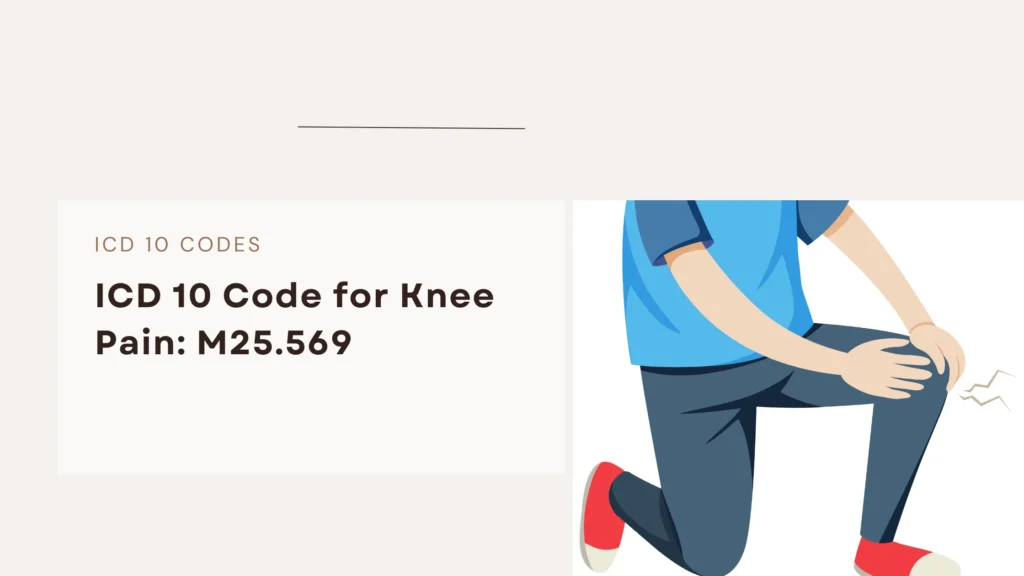
The ICD 10 code for knee pain most commonly used is M25.569. It is used when the exact cause or location within the knee isn’t specified. This code falls under the broader category of M25, which includes other joint disorders that are not classified elsewhere.
ICD 10 Code for Knee Pain: A Complete Guide
Knee pain is one of the most common complaints people have when visiting healthcare providers. It can come from injury, aging, arthritis, or other causes. Accurate diagnosis and treatment depend heavily on proper documentation, and coding systems like the ICD 10 help healthcare professionals communicate about patient conditions clearly.
This article covers all you need to know about the ICD 10 codes for knee pain, their variations, and guidance for choosing the right code.
What are ICD 10 Codes?
The International Classification of Diseases, Tenth Revision (ICD-10) is a standardized system used worldwide to classify and code all diagnoses, symptoms, and procedures recorded in healthcare settings. It helps in keeping a uniform language for diseases and conditions, which is essential for statistics, billing, and patient care.
When it comes to knee issues, several ICD 10 codes describe different conditions, particularly various types of knee pain. The ICD 10 code for knee pain acts as a label that tells insurers and medical staff precisely what kind of knee pain is being treated.
Explanation of ICD 10 Code M25.569
M25.569 specifically stands for “Pain in unspecified knee.” It is a versatile code used in scenarios where a patient reports knee pain, but diagnostics haven’t pinpointed whether it is in the right or left knee, or whether the pain is bilateral or due to a particular condition.
This code (M25.569) acts as a placeholder in medical documentation and billing when the clinician knows the patient has a painful knee but hasn’t identified an exact source or side.
It’s especially useful during initial examinations or in cases where detailed diagnosis might still be pending.
Why is the ICD 10 M25.569 code important?
Using the correct general code like M25.569 ensures that the patient’s complaints are recorded accurately, even if the exact cause or side isn’t clear right away. However, once more diagnostic details are available, more specific codes should replace this standard code to assist in precise treatment planning and insurance claims.
The ICD 10 allows further specification of knee pain codes with a seventh character:
- M25.5691: Pain in the right knee, unspecified cause
- M25.5692: Pain in the left knee, unspecified cause
- M25.5699: Pain in an unspecified knee, cause unknown or not specified
These extensions help pinpoint the exact side of pain when known but still indicate that the precise diagnosis, like osteoarthritis or injury, hasn’t been established yet.
Application of ICD 10 Code for Knee Pain
In clinical settings
Healthcare providers often use M25.569 as a temporary code until further evaluations like MRI or X-ray reveal the source.
In medical billing
Proper documentation of knee pain, even if unspecified, helps insurers process claims without delays, especially when additional tests are pending.
In research and statistics
This code helps track the prevalence of knee complaints when the exact cause isn’t always immediately known.
Other ICD 10 Codes Related to Knee Pain
The ICD-10 coding system provides specific codes to categorize knee pain based on the precise clinical scenario. Here’s a detailed look at each scenario:
ICD-10 Code for Bilateral Knee Pain
Technically, there is no single ICD-10 code for “bilateral knee pain”. When both knees hurt at the same time, generally preferred code is M25.561. Although some might think there’s a separate bilateral code, M25.561 is widely accepted for pain in both knees, especially if detailed side-specific diagnosis isn’t documented. This helps ensure both affected areas are properly acknowledged in records.
ICD-10 Code for Right Knee Pain
Right knee pain is specifically coded as M25.561. This code is essential for precise documentation, especially if the pain is localized and diagnosed as stemming from a particular injury or condition affecting only the right side. Clear right side coding benefits targeted treatment plans and accurate insurance claims.
ICD-10 Code for Left Knee Pain
For pain in the left knee, the code is M25.562. Using this code helps differentiate between the limbs, supports detailed clinical notes, and ensures the right side receives focused care. It’s especially important in cases like post-injury or chronic degenerative conditions affecting only the left knee.
ICD-10 Code for Knee Pain with Swelling
When knee pain is accompanied by swelling, clinicians typically use the relevant pain code—either M25.561 (bilateral or right) or M25.562 (left)—together with a symptom code like M25.462 for effusion or swelling. This combination provides a comprehensive picture of the patient’s condition, guiding both treatment and billing procedures.
ICD-10 Code for Knee Pain in Both Knees
In cases where a patient experiences pain in both knees but the documentation doesn’t specify sides, using M25.561 is most appropriate because it covers bilateral pain. This code simplifies documentation when laterality details are not known, ensuring the condition’s documentation is clear and billing is accurate.
ICD-10 Codes for Knee Pain with Swelling and Other Symptoms
Knee pain often comes with extra problems i.e. swelling, effusion, or inflammation. To capture this accurately, healthcare providers pair the main knee pain code with symptom codes.
For example, swelling or fluid buildup in the knee gets coded with M25.462 for effusion. So, if a patient has pain and swelling, a typical documentation would be M25.561 (for right knee pain) combined with M25.462.
This duo provides a clear, complete picture of what’s going on, which helps in choosing the right treatment and billing accurately.
Injury-Related Knee Pain ICD-10 Codes
In cases where knee pain is caused by an injury—a fall, twist, or blow—special injury codes from the S00–S99 range are used along with the pain codes.
For example, a torn meniscus or ligament sprain might be documented with S83.92XA (sprain of unspecified site of the left knee, initial visit). Using injury-specific codes like these ensures that the cause of pain is clearly recorded, guiding both treatment and insurance claims.
Remember, always include details like the cause (fall, accident, trauma) to stay compliant and precise.
How to Use the ICD 10 codes for Knee Pain
Knee pain can vary widely in type and location, so the ICD 10 coding system assigns specific codes to accurately describe each situation. Whether the pain is in one knee, both knees, or accompanied by swelling, these codes help healthcare providers document the exact condition. Choosing the correct code ensures clear communication, proper treatment, and smooth billing.
Case 1: Right Knee Pain (M25.561)
Mr. Smith, a 45-year-old recreational soccer player, twisted his right knee during a game. He suffers sharp pain localized to the right knee, accompanied by mild swelling but no prior history of injury. His physician documents the pain in the right knee after clinical examination and imaging, assigning the ICD 10 code M25.561 for pain in the right knee. This code accurately reflects his condition for both treatment and insurance purposes.
Case 2: Left Knee Pain with Swelling (M25.562 + Swelling Code)
Mrs. Lee, a 60-year-old woman with osteoarthritis, reports chronic pain in her left knee along with noticeable swelling and stiffness after a long walk. The clinician documents the pain as M25.562 for left knee pain and adds an additional code for swelling to capture the full clinical picture. This combination ensures comprehensive care planning and precise medical billing.
Case 3: Unspecified Knee Pain in Both Knees (M25.569)
John, a 50-year-old office worker, complains of general pain in both knees but cannot specify which knee hurts more or less. His doctor records the symptom using the ICD 10 code M25.569 (pain in unspecified knee). Since laterality isn’t defined, this code serves as an initial documentation while further tests are pending for more specificity.
These examples show how choosing the right ICD 10 knee pain code depends on patient symptoms, injury specifics, and clinical documentation, ensuring precise communication and billing.
ICD-10 Code Updates 2025
To add more detail, ICD-10 codes have “seventh character” extensions for laterality and encounter type. So, M25.5691 indicates pain in the right knee (unspecified cause), while M25.5692 refers to left knee pain. These extensions help clarify exactly which knee is involved, especially in follow-up visits or chronic conditions.
Staying updated with the current ICD-10 guidelines,like those from FY25, ensures your coding is accurate, supports correct billing, and keeps your records compliant with official standards.
Reimbursement for ICD 10 Code for Knee Pain
ICD-10 codes, like the ones for knee pain, do not have direct reimbursement rates because they are diagnostic codes used to specify the patient’s condition.
Reimbursement is determined primarily by CPT (Current Procedural Terminology) codes, which describe the specific medical procedures or services performed based on the diagnosis.
For knee pain, CPT codes related to treatments—such as arthroscopy, injections, or surgeries—have associated reimbursement rates that vary by payer and location.
For example, procedures related to knee pain include:
- CPT 20610: Arthrocentesis (joint aspiration or injection) of major joint (like the knee).
- CPT 29881: Knee arthroscopy with meniscectomy.
- CPT 27447: Total knee arthroplasty (replacement surgery).
Reimbursement rates for these CPT codes in 2025 can range from about $150 to over $1,200 depending on the exact procedure and payer policies.
In summary, while ICD-10 codes describe knee pain without direct reimbursement rates, they guide procedure coding, which impacts reimbursement.
For accurate billing and reimbursement, knowing both the diagnosis code and the related CPT procedure codes is essential.
FAQs
Here are answers to your questions:
Can ICD-10 codes for knee pain affect claim approvals?
Yes. Using unspecified codes (M25.569) too often may lead to claim delays or denials. Insurers prefer specific codes that indicate laterality (right, left, bilateral) and cause. Accurate coding improves first-pass claim approval rates.
What is the “parent code” in ICD-10, and why should it not be used alone?
- Parent code: M25.56 (Pain in knee)
- Reason not to use alone: It doesn’t specify laterality or cause, which is necessary for proper billing and treatment documentation. Always use subcodes like M25.561 (right knee) or M25.562 (left knee).
How do seventh-character extensions work for knee injuries?
Seventh characters in injury codes indicate encounter type:
- A = Initial encounter
- D = Subsequent encounter
- S = Sequela (complication or late effect)
Example: S83.92XA → Sprain of left knee, initial encounter. These characters ensure proper documentation of the treatment stage.
Can ICD-10 codes for knee pain be combined with other codes?
Yes. Combination coding is important for complex scenarios:
- Pain with swelling/effusion: Combine pain code (M25.561/562) with M25.462.
- Pain after injury or accident: Combine pain code with S-codes (sprain/strain) or W-codes (cause of accident).
This ensures comprehensive documentation and smooth insurance processing.
What should I do if the patient has knee pain but no clear cause is identified?
- Use M25.569 (unspecified knee pain) temporarily.
- Conduct further diagnostics (X-ray, MRI) to identify the exact source.
- Replace the unspecified code with a more specific code once the diagnosis is confirmed.